

Viewing Habits 2026 Reward Films That Linger

A film does not need to seize a viewer by the throat in its first eight seconds to earn their attention. The more interesting shift in viewing habits 2026 is not that people have suddenly become patient. It is that more viewers are choosing when, where and how to give a film their full attention - and becoming far less tolerant of work that mistakes noise for impact.
For independent horror, this matters. The audience that will sit with dread, ambiguity and unresolved images has not vanished beneath the weight of clips, feeds and autoplay. It has become more selective. It wants a reason to press play, a clear sense of authorship, and something substantial enough to discuss after the credits.
Viewing habits 2026 are not a race for shorter attention
The lazy story about modern audiences is that everyone wants everything faster. Faster openings. Faster plots. Faster explanations. There is some truth in it: the first decision is made quickly, often from a thumbnail, a trailer, a recommendation or one sharp sentence from someone whose taste carries weight. Discovery is compressed.
But discovery is not viewing. Once a film has earned the click, many people want the opposite of relentless acceleration. They want atmosphere. They want to feel a scene gathering pressure rather than announcing its purpose. They want an image with enough confidence to hold for a few seconds longer than expected.
That is especially true for cinephiles who have spent years being served interchangeable genre products. A barrage of jump scares can produce a reaction. It cannot automatically produce a memory. Psychological horror works differently. It invites the viewer to notice the space around a character, the instability in a performance, the threat that may be real or may be self-created. Its pace is part of its argument.
The trade-off is real. Slow-burn cinema asks for more than a casual glance while scrolling between messages. It will lose viewers looking for uncomplicated comfort or a quick burst of adrenaline. Pretending otherwise is a mistake. The point is not to make every film fit every mood. It is to present the experience honestly, so the right viewer arrives prepared for it.
The living room has become a screening room - sometimes
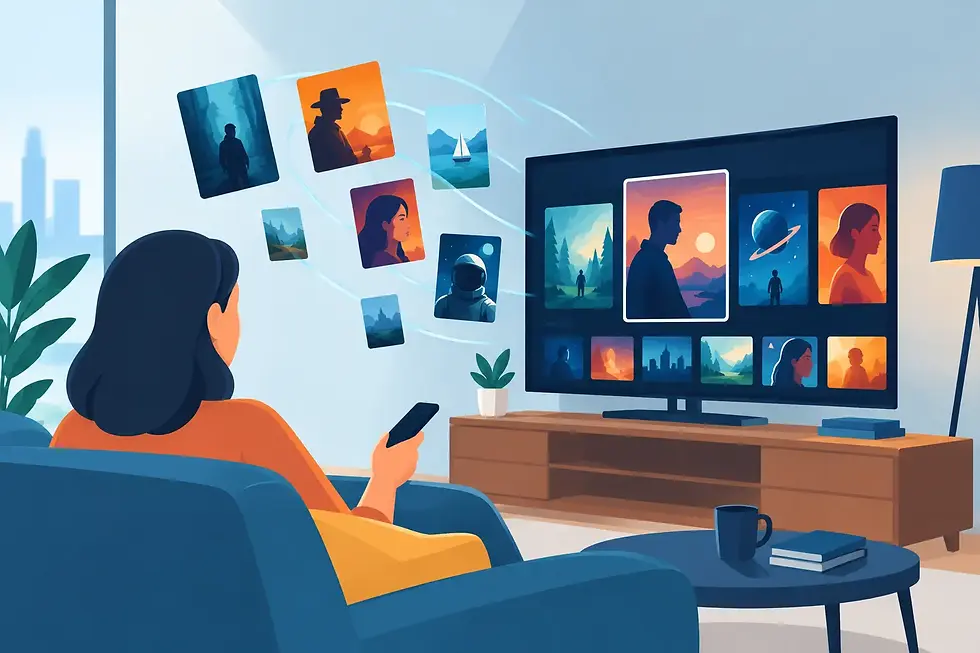
Home viewing is no longer automatically second-best. A large television, proper headphones, a darkened room and a deliberate choice can create an intense encounter with a film. For viewers outside major cities, or for anyone unwilling to pay cinema prices on a speculative night out, direct access can be the difference between seeing an independent film and missing it entirely.
Free viewing has particular force here. It removes the final barrier between curiosity and commitment. A trailer can establish tone, cast and visual world; the full film is then available without a rental prompt arriving at the moment interest peaks. That model respects an audience willing to take a chance on unfamiliar work.
Yet accessibility should not be confused with disposability. A film on YouTube can be treated as background material, paused without thought and abandoned after three minutes. It can also be watched with more concentration than many multiplex releases, because the viewer has actively sought it out. The platform does not determine the seriousness of the encounter. The framing does.
A strong presentation tells people what kind of attention a film deserves. Not through pleading or inflated claims, but through precision. Say that it is slow-burning psychological horror. Put the director's vision, the performances and the texture of the imagery at the centre. Let viewers know they are not being offered another disposable genre snack.
Trailers must create a question, not explain the film
The trailer remains the pressure point of viewing habits in 2026. It has to work in a crowded, distracted environment, but it must not flatten the feature into a list of plot turns. This is a difficult balance for surreal or character-led horror, where mystery is not packaging. Mystery is the engine.
The most effective trailers do not promise that every question will be answered. They promise a specific feeling: unease, fascination, a fracture in ordinary life. They introduce an image that cannot be easily filed away, or a line reading that carries more weight than its context reveals. The viewer should come away thinking, “What is happening here?” rather than, “I have already seen the whole thing.”
For a film with a deliberately patient rhythm, the trailer also has to signal that patience as an artistic choice. The wrong trailer can sell a feverish jump-scare ride and create the wrong contract with the audience. The right one finds tension in sound, shadow, faces and withheld information. It attracts viewers who understand that a slow film is not necessarily a quiet film.
This is where auteur identity becomes practical rather than ornamental. A writer-director's name, an anamorphic frame, a British-Asian perspective, a distinctive visual grammar: these are not merely credentials. They help the viewer recognise that the film has a point of view. In an abundance of content, point of view is a stronger lure than generic familiarity.
Polarised reactions are a sign of life
The most forgettable films often produce the neatest agreement. Everyone thinks they were fine. Nobody feels compelled to return to a scene, challenge an interpretation or send a message at midnight insisting that the ending means something else.
A divided response is not automatically evidence of quality. Some films are simply muddled, thin or careless. But when a film is formally purposeful and morally unsettled, disagreement can be the proof that it reached beyond passive consumption. One viewer sees control; another sees cruelty. One calls it hypnotic; another calls it opaque. The friction is part of the experience.
That is a better conversation than the empty question of whether a film is “worth watching”. Worth to whom? In what state of mind? With what expectations? A viewer who wants clean exposition may reject a work that another viewer finds haunting precisely because it leaves room for uncertainty.
Ride the Snake is built for that space: one film, four radically different verdicts. That is not a defensive slogan. It is an invitation to watch closely enough to have a verdict of your own.
Attention now has to be designed, not demanded
There is no virtue in making a film obscure for its own sake. Nor is there any shame in wanting an audience. The challenge for independent cinema is to make its invitation as considered as the work itself.
That means choosing a trailer that conveys tone without stripping away discovery. It means making cast, craft and authorship visible to people deciding what to watch. It means accepting that some viewers will leave, while ensuring that those who stay have been given a real experience rather than a marketing promise.
It also means respecting the conditions of home viewing. Encourage a full-screen watch. Let the sound do its work. A mobile phone on the sofa is not a moral failure, but it changes the rhythm of a film designed around glances, silence and accumulating dread. The best direct-to-audience releases make the case for attention without turning it into homework.
What viewers should look for next
The valuable habit is not watching more. It is choosing more deliberately. When a film seems strange, slow or difficult, the useful question is not whether it behaves like everything else on the home page. Ask whether its choices are creating a world you have not entered before.
Give a film ten uninterrupted minutes when you can. Watch the trailer only once if you want to preserve its surprises. Let a divisive ending sit overnight before looking for a consensus that may only dull it. And if a film leaves you unsettled, irritated or unable to stop thinking about one image, do not rush to resolve the feeling. That may be the film still working on you.


Comments