

Surreal Thriller Performance Review of Ride the Snake

A surreal thriller performance review has to ask a different question from a conventional horror review: not simply whether the cast makes us afraid, but whether they can make the unreal feel emotionally unavoidable. In Ride the Snake, performance is not decoration around the dread. It is the pressure system beneath it. Every withheld reaction, strained pause and uncertain glance helps turn a slow-burning psychological horror into something more intimate and destabilising.
This is a film that asks its actors to play inside ambiguity. The characters are not handed neat emotional labels or clean exits. They are caught in moral weather, where the atmosphere may be telling the truth, lying outright, or reflecting an interior collapse. That demand gives the performances their particular charge.
A surreal thriller performance review: fear in the margins
The strongest choice in Ride the Snake is restraint. Rather than signalling terror at full volume, the acting often allows anxiety to gather at the edges of a scene. A line can land a fraction too flat. A stare can hold for just long enough to become confrontational. A body can remain still while the face reveals that stillness is no longer safety.
That is crucial in surreal horror. If every character reacts as though they are trapped in an ordinary thriller, the artifice shows. The genre needs performers who understand that the most disturbing response is sometimes uncertainty. Is this person frightened, complicit, exhausted, or attempting to keep control? The film lets those possibilities coexist.
The result is an acting style that does not explain itself away. Viewers looking for immediate emotional signposting may find the approach elusive. But that elusiveness is the point. Ride the Snake gives its audience room to read the performances, then question the reading once the next image arrives.
The tension comes from what is not said
Dialogue in psychological horror can be a trap. Too much exposition turns dread into a puzzle with instructions; too little can leave characters feeling like pieces of production design. Here, the dramatic weight sits in the gaps between speech.
Conversations feel charged by incomplete knowledge. Characters appear to be listening for something beneath the words, whether it is accusation, desire, shame or threat. The cast makes those subtexts legible without reducing them to a single answer. That is harder than overt display. It requires precision in timing, rhythm and eye contact, particularly when the film’s surreal logic refuses to offer firm ground.
This gives ordinary exchanges an uneasy afterlife. A phrase that initially seems casual can become sinister in retrospect. A moment of apparent tenderness can acquire the texture of control. The performances understand that horror does not always arrive through intrusion. Sometimes it is already present in the way people speak to one another.
Moral ambiguity needs control, not vagueness
There is a difference between ambiguity and absence. The characters in Ride the Snake may resist easy categorisation, but the performances do not feel empty. They are built from clear internal decisions, even when the audience is deliberately denied access to every motive.
That distinction matters. Surreal cinema can invite projection, but it still needs human stakes. The cast grounds the film’s more unnerving turns in recognisable emotional behaviour: defensiveness, hesitation, denial, brittle confidence and the urge to make an unbearable situation sound reasonable. These are not grand gestures. They are survival tactics.
The film’s psychological tension therefore feels earned. We are not being told that a character is compromised. We watch composure harden, slip and reassemble. We notice how one person’s silence alters another person’s posture. The horror develops through social pressure as much as visual threat.
Anamorphic space becomes part of the acting
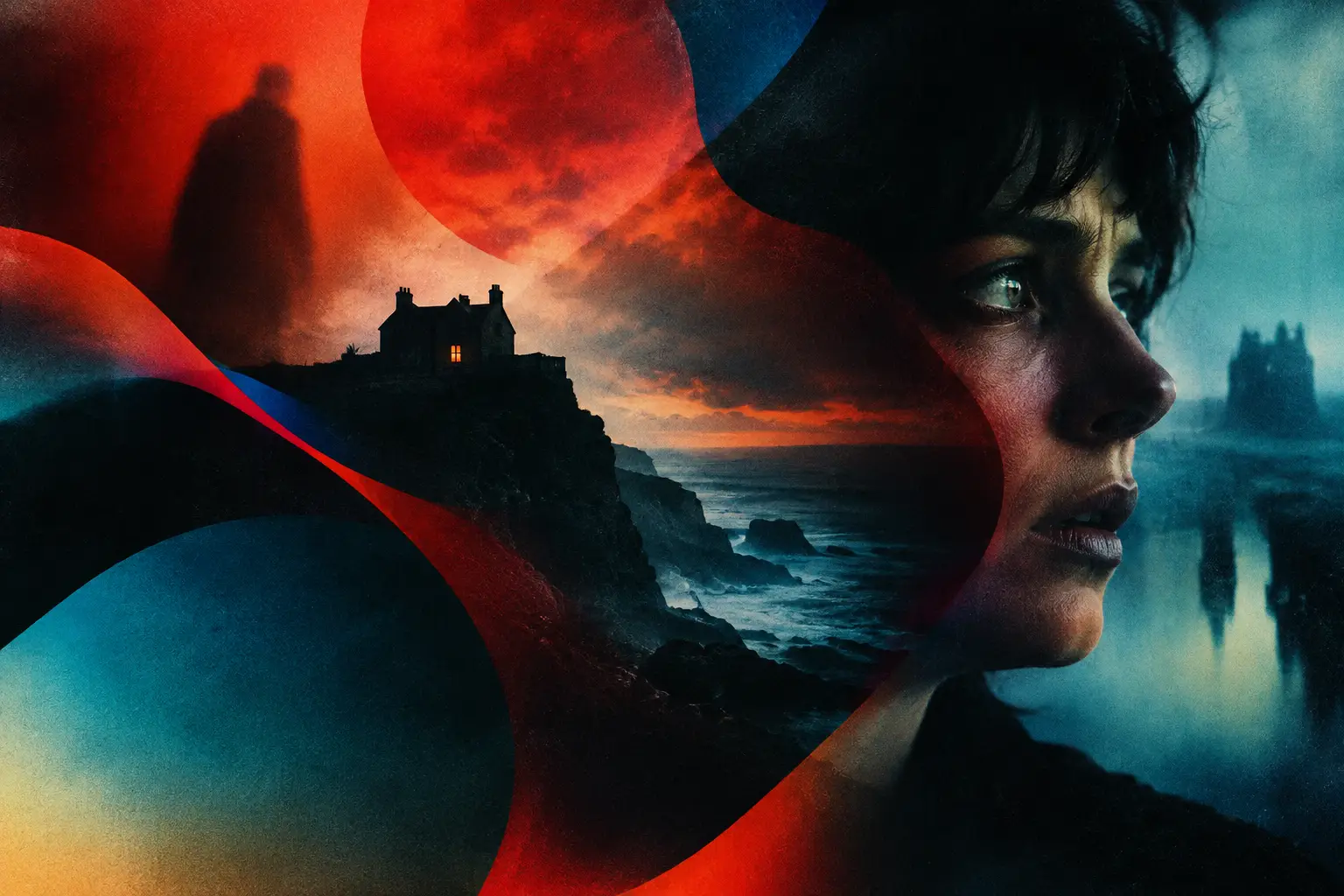
The textured anamorphic cinematography does more than provide an elegant surface. It changes the conditions of performance. Faces are often held against space that feels too open, too shadowed or too uncertain to offer protection. The frame can make a figure look isolated even when another person is close by.
That visual strategy asks the actors to work with distance. They have to register across rooms, through darkness and within compositions where the environment carries as much menace as the dialogue. A smaller movement has to be exact. A held expression has to survive the camera’s scrutiny.
At its best, the film creates an unnerving relationship between face and setting. The characters do not simply inhabit the image. They seem to be tested by it. Rooms, corridors and landscapes become emotional amplifiers, drawing out suspicion or exposing a fragility that might otherwise remain hidden.
This is where the film’s formal confidence and its performances meet. The imagery never needs to announce that it is strange. The cast supplies the friction. Their reactions tell us when a space has become hostile, not because they scream at it, but because their behaviour has subtly stopped belonging to everyday life.
Slow burn is a performance test
A slow-burning psychological horror lives or dies by its ability to keep tension active before the obvious rupture arrives. That burden falls heavily on the performers. They must sustain attention when the script is withholding answers, and they must make the audience feel that something is changing even when almost nothing appears to happen.
Ride the Snake understands this discipline. Its acting does not chase the audience with constant intensity. Instead, it allows mood to accumulate. The film trusts a delayed response, a shift in tone, a moment when a character seems to recognise something they cannot safely articulate.
There is a trade-off. Those expecting jump scares, neat motivations and aggressively accelerated plotting may mistake this patience for distance. But viewers drawn to arthouse horror will recognise the method: unease is being composed, not merely delivered. The performances are central to that composition because they keep the film’s emotional temperature unstable.
A conventional thriller often asks, “What will happen next?” This film more often asks, “What has already happened to these people, and what are they refusing to face?” The cast gives that question its force. Even at their most guarded, the characters suggest histories pressing against the present.
British-Asian specificity without shorthand
The film’s British-Asian creative identity also matters to the way its dramatic tensions register. Cultural specificity is not a costume that can be added after the fact. It lives in social codes, family pressure, authority, belonging and the things people learn not to say directly.
Ride the Snake does not need to flatten those forces into a statement of intent. They emerge through behaviour and emotional restraint. That gives the performances texture. The characters carry competing obligations, private fears and public roles, and the friction between them feels lived rather than diagrammed.
For a British audience accustomed to psychological horror that too often treats culture as a visual shorthand, this is a more interesting proposition. The film locates unease in human dynamics rather than spectacle alone. Its identity informs the atmosphere, but never becomes a substitute for character.
Why the acting lingers
The most effective performances in surreal thrillers tend to linger because they do not close the case. Days later, a viewer may return to a look, an interruption or a sudden change in composure and see it differently. Ride the Snake is designed for that kind of reappraisal.
Its actors do not ask for easy sympathy. They ask for attention. That can be a more demanding exchange, especially for viewers trained by mainstream horror to wait for clear victims, clear villains and clean catharsis. Yet it is also what makes the film discussion-worthy. The performances leave space for disagreement without becoming arbitrary.
One viewer may see a character’s reserve as guilt; another may see self-protection. One may read a moment as supernatural menace; another may see the unbearable logic of a damaged relationship. The film has enough control to support those competing verdicts.
Verdict: performances that make uncertainty dangerous
As a surreal thriller performance review, the clearest verdict is that Ride the Snake finds its menace in control. The cast does not overplay the nightmare. It lets it seep into voices, silences and physical distance, allowing the audience to feel the strain before it can fully name its source.
That approach will not suit every horror viewer, and it is not trying to. This is cinema for those willing to sit with uncertainty, to watch a face for an extra second, and to accept that the most frightening thing on screen may be a person trying very hard to appear unaffected.
Give the film your full attention and, when the credits roll, resist the urge to settle its meaning too quickly. The strongest performances here are built to keep moving after the image has gone dark.


Comments