

How to Analyse Horror Subtext Without Killing It

A hallway is never only a hallway in horror. It can be a family history with the lights switched off, a social boundary, a route back to an injury a character refuses to name. Learning how to analyse horror subtext means staying alert to that second meaning without reducing every shadow to a neat symbol.
The best psychological horror does not conceal a moral in the final reel and ask you to retrieve it. It creates pressure between what a film shows and what it cannot quite say aloud. A haunted house may be about grief. It may be about class, inheritance, colonial violence, maternal rage or the fear of becoming one’s parents. Often, it is about several things at once. The point is not to solve the film. The point is to recognise how its formal choices make an anxiety felt.
Start with the threat, then ask what it disturbs
Begin at the most basic level: what is frightening here? Not simply what creature appears, or who is in danger, but what kind of order is being broken.
A home invaded by an unknown presence may disturb the idea that domestic space is safe. A body that changes beyond recognition may threaten ideals of bodily control, beauty, gender or health. A protagonist who cannot trust their own memory turns perception itself into hostile territory. Horror works because it makes a familiar structure unstable.
Ask three questions of the central threat. What does it force the characters to confront? What ordinary comfort does it corrupt? And why does the film need this particular form of terror rather than another? A faceless apparition, for instance, carries different implications from a violent neighbour whose motives are painfully recognisable.
Do not settle for a one-word answer. Saying that a film is “about trauma” may be true, but it is only a doorway. Whose trauma? Shaped by what environment? Does the film treat it as private pain, inherited damage, social neglect, or something more unsettling? Specificity is where analysis begins.
How to analyse horror subtext through form
Subtext does not live solely in plot. In serious horror, the camera, edit, soundscape and production design are doing their own argumentative work. If the story tells you one thing while the form makes you feel another, trust the tension between them.
Look at what the camera withholds
Frame composition tells you where danger is allowed to exist. A character pushed to the edge of the image may appear trapped before anything attacks them. Empty space behind a figure invites suspicion. A low angle can make an ordinary room oppressive; a distant wide shot can turn a person into a small, exposed shape inside an indifferent landscape.
Pay attention to repetition. If doorways, mirrors, corridors or windows recur, do not assume they have one fixed symbolic meaning. Notice how their meaning changes. A mirror may first suggest vanity, then fractured identity, then the terror of being watched by oneself. Horror frequently turns visual motifs into evolving emotional evidence.
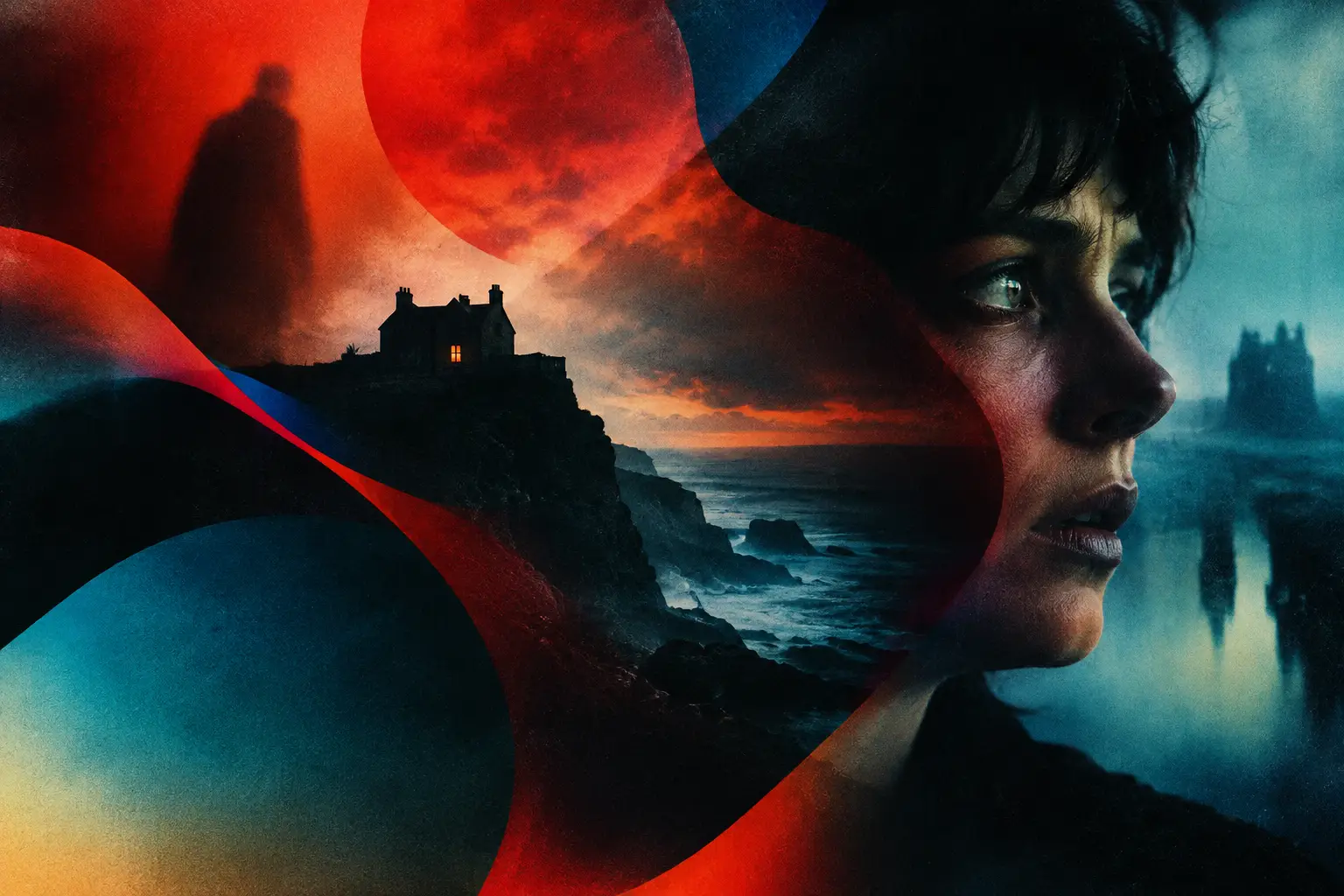
Anamorphic imagery can be especially potent here. Its horizontal breadth may make a domestic setting feel stretched, estranged or full of negative space. The image does not need to announce its significance. It can quietly make a supposedly safe room feel too wide to control.
Hear the film’s hidden argument
Sound is often the shortest route to horror’s buried meaning. Listen for noises that do not belong, but also for sounds that belong too much: a boiler knocking, a neighbour arguing through a wall, cutlery against a plate, breathing that becomes impossible to ignore.
Silence matters just as much. When a soundtrack falls away, the film may be withholding emotional reassurance. It leaves the viewer alone with a character’s uncertainty. A sudden musical sting can startle, but prolonged unease is more often built from duration, muffled detail and sounds whose source remains unclear.
Ask whether the sound is objective. Can everyone hear it, or only one character? If only one person hears a child crying, a repeated phrase or a distant animal call, the question is not merely whether they are imagining it. The sound may externalise guilt, longing, paranoia or an experience nobody around them is willing to acknowledge.
Treat pace as meaning, not a delivery problem
Slow-burning horror is sometimes dismissed as if pace were separate from content. It is not. A film that delays confirmation can place you inside the exhausting rhythm of dread: waiting for bad news, doubting your own judgement, living with an atmosphere others dismiss.
Consider what the waiting does. Does it make the protagonist appear isolated? Does it force the audience to scan rooms and faces for clues? Does it replicate the suffocation of an unhappy marriage, a hostile workplace, a family secret or an old wound that will not stay buried? A deliberate pace can make dread social as well as supernatural.
That said, not every slow film is profound. If repetition does not sharpen character, alter our understanding or deepen the atmosphere, it may simply be repetition. Good analysis allows for that possibility. Interpretation is not automatic praise.
Follow the character’s contradiction
Horror protagonists are rarely reliable in the straightforward sense. Even when they tell the truth, they may not understand it. Their contradiction is often the film’s pressure point.
Watch what a character says they want, then watch what they repeatedly do. Someone may claim to be protecting their family while controlling every movement inside the home. Another may insist they want answers while destroying the evidence that would give them clarity. These gaps can expose repression, shame, dependency or fear of change.
Relationships are equally revealing. Who is believed and who is dismissed? Who performs care, and who receives it? If a woman’s alarm is treated as hysteria, or a working-class character’s testimony is ignored by people with institutional authority, the film may be engaging with a social reality through genre language. The monster need not stand for one thing. It can intensify a condition already present in the world of the film.
This is particularly relevant when considering culturally specific horror. Do not flatten a film’s setting, religion, race or family dynamics into decorative context. Ask how those details shape the characters’ available choices. A fear rooted in intergenerational expectation, migration, masculinity or communal scrutiny has a distinct texture. It deserves more than a universalised reading that calls everything simply “human”.
Separate evidence from association
A persuasive reading needs evidence. You may associate a red room with rage, blood or danger, but the colour becomes meaningful only through the film’s pattern of use. Does red appear at moments of intimacy? Around a particular figure? In contrast to a drained, colourless environment? The stronger the pattern, the stronger the claim.
Use scenes, gestures, cuts and recurring images as your evidence. Describe what happens before declaring what it means. This protects you from the most common analytical mistake: forcing a theory onto a film that has not earned it.
It also leaves room for ambiguity. A final image can suggest liberation and annihilation at once. An apparition can be real within the story while still carrying psychological force. Horror is unusually good at keeping literal and metaphorical readings alive together. You do not have to choose one if the film is deliberately making both unstable.
Test your reading against the ending
The ending is not a decoding key, but it can test the interpretation you have built. Does the conclusion restore order, expose its impossibility, or pretend to restore it while leaving an infected trace? Who pays the price for survival? What has changed in the image, sound or behaviour of the remaining characters?
A tidy explanation may reveal that the film’s terror came from misrecognition. An unresolved ending may refuse the comfort of diagnosis. Neither approach is inherently superior. What matters is whether the final movement transforms the anxieties the film has been staging, rather than merely withholding information for a last-minute trick.
If you are writing about the film, end on the friction rather than the verdict. The most interesting horror leaves a remainder: an image you cannot rationalise away, a moral compromise that still feels wrong, a question the ending has made sharper. That is where discussion begins.
Ride the Snake invites precisely this kind of attention: not a passive hunt for answers, but a confrontation with mood, memory and the meanings that keep shifting after the screen goes dark. Watch closely, make a case, then leave enough darkness in the frame for another viewer to disagree.


Comments